
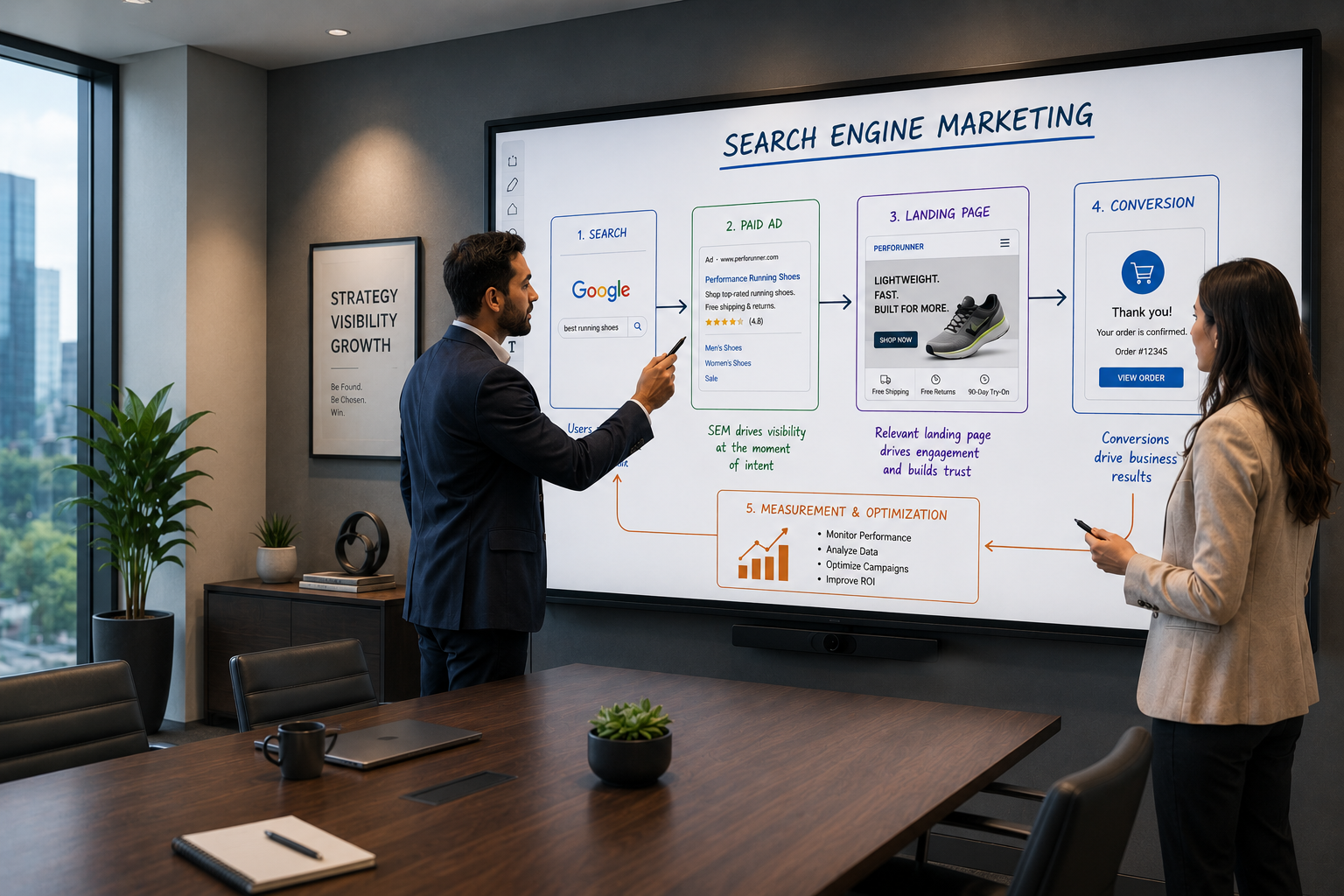
Be there when buying decisions are made
Search remains one of the most powerful places to reach buyers because they are actively looking for information, products and solutions. We build search engine marketing programs that strengthen your visibility across Google and the evolving AI-driven search environment.
Build visibility where your customers are searching
Search engine marketing has evolved beyond keywords and rankings. Your website, content and external authority need to work together to establish what your organization does, what it is authoritative about and why search and AI systems should trust it.

Optimize your foundation
Strengthen website structure, content, keywords and internal linking to improve relevance and visibility for the searches that matter.

Build topical authority
Create optimized service pages, blogs, FAQs and geo content that expand your expertise and the searches your website can capture.

Strengthen domain authority
Build permanent, high-authority backlinks from relevant websites with real organic traffic to strengthen your competitive position.
Learn more about our link building programs

Expand your digital presence
Build credible third-party references that reinforce your business, services and geographic relevance across the broader digital ecosystem.
Why invest in search engine marketing?
-
Capture buyer intent
Reach prospects while they are actively searching for the products, services and expertise your organization provides.
-
Build lasting visibility
Develop organic positions that can continue generating relevant traffic and opportunities without paying for every individual click.
-
Strengthen digital authority
Build the content, links and external signals that increase the overall credibility and competitive strength of your domain.
-
Compete across search and AI
Strengthen the digital signals that support visibility across Google search results and increasingly important AI-driven discovery.
-
Expand your search footprint
Target additional services, questions, topics and geographic markets to create more relevant ways for customers to discover you.
-
Measure your progress
Track rankings, authority and organic visibility to understand where performance is improving and where additional opportunities remain.
Transparent pricing
Our organic SEO programs start at $3,000 per month, with programs scaled to your competitive position, target markets and growth objectives.
FAQs
Request a Search Engine Impact Report.
It includes:
-
Competitive keyword analysis
-
Domain authority assessment
-
Content gap analysis
-
Ranking difficulty by geography
This gives you a clear forecast of your chances of success and what investment is required.
SEO targets traditional search engines like Google. AIO targets AI-driven platforms like ChatGPT, Gemini, and Perplexity that deliver direct answers instead of blue links.
The two often overlap:
-
Pages with strong SEO (clear answers, credible sources, optimized structure) are also more likely to be indexed and cited by AI engines.
ChatGPT, for example, builds its responses by analyzing billions of high-quality, structured sources.
If your content ranks well on Google, there’s a higher chance it becomes part of that data ecosystem.
Off-page SEO is what happens outside your website that helps improve your rankings.
Key examples:
-
Backlinks from authoritative websites
-
Press mentions
-
Social media shares
-
Influencer citations
-
User engagement elsewhere on the web
The goal is to build trust and authority. Google sees these as signals that your content is respected.
On-page SEO refers to everything you can control directly on your website to improve rankings.
This includes:
-
Keyword usage and structure
-
Page titles, headers, and metadata
-
Internal linking
-
Image optimization (size, alt text)
-
Fast mobile-first performance
-
Video treatment and schema
It’s the foundation of visibility — you’re making the site easy to read for both humans and Google.
A combination of on-page and off-page factors.
-
On-page SEO involves how well your content is optimized with keywords, internal linking, image and video structure, and page performance.
-
Off-page SEO refers to inbound links, social sharing, traffic signals, and the overall authority of your website.
Search engines prioritize useful, fast, relevant content backed by credible signals like backlinks and engagement.
Think of it this way:
-
On-Page SEO tells Google what your page is about.
-
Off-Page SEO tells Google your content is credible.
Both are critical — optimizing only one without the other will limit your ability to rank competitively.
No. According to OpenAI CEO Sam Altman, ChatGPT is designed to complement search, not replace it.
-
It excels in summarizing, synthesizing, and guiding, but still points users back to the web.
-
Google itself is evolving into an AI-powered search engine (Search Generative Experience).
Bottom line: AI and Search work together — and visibility on both now matters.